
Meat boot camp

I have just finished a couple of properly amazing weeks at The School of Artisan Food, as a student on their ‘Artisan Butchery Fundamentals’ course.  The School of Artisan Food is based on the Wellbeck Estate, just outside Worksop in Nottinghamshire.  It is an extraordinary estate, still in the original family ownership, although the dukedom (of Portland) has been lost in the absence of a male heir.  A previous duke had tunnels dug under the estate of suitable proportions to allow him to travel by horse and carriage around the estate without having to venture above ground.  He also self trepanned (drilled a hole in his skull)!  His story is told in a fabulous novel ‘The Underground Man’ by Mick Jackson.
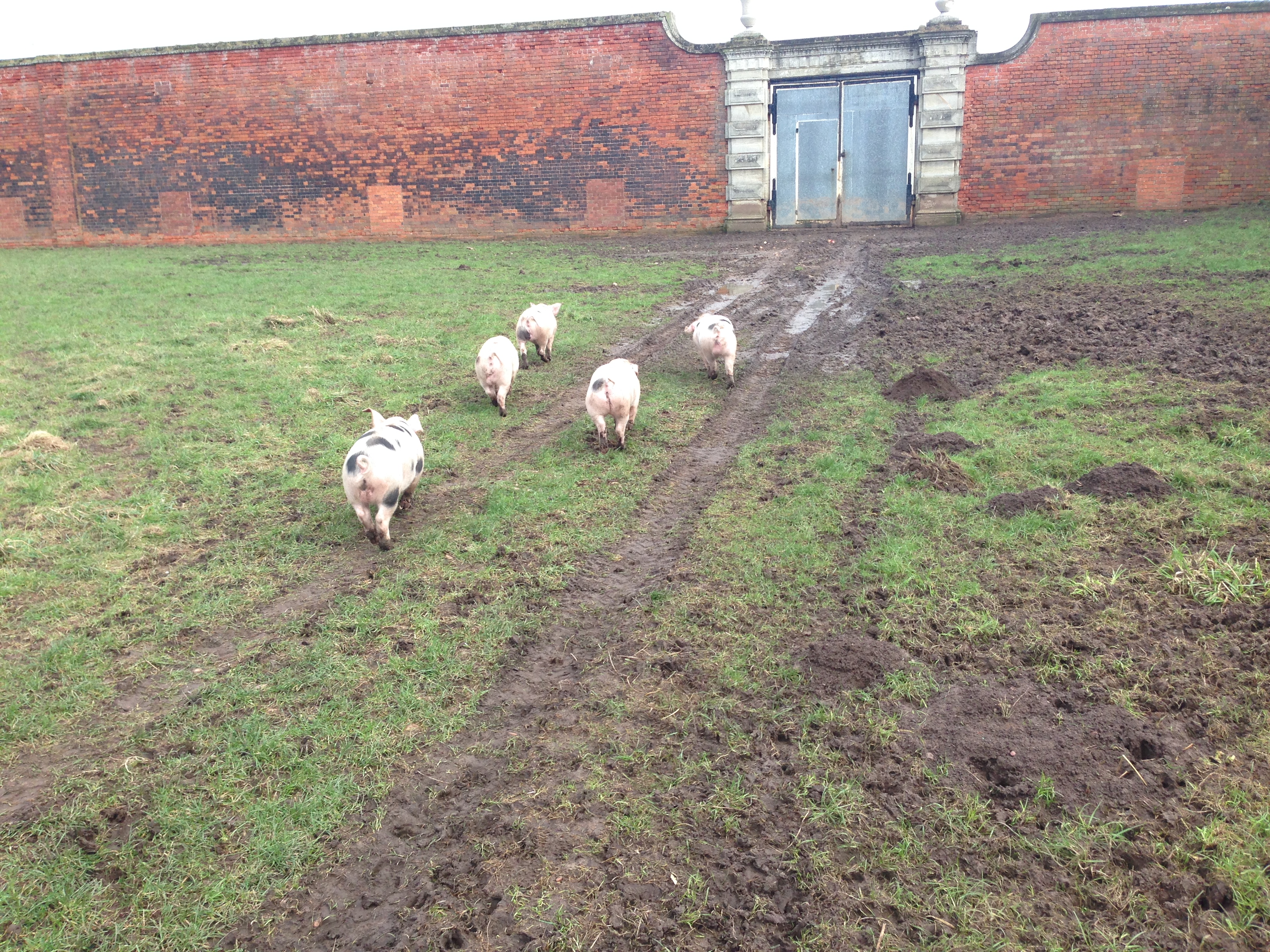
Gloucester Old Spot Piglets in the Old Walled Garden at Wellbeck Estate

Magnificent through the estate is, that is not what drew me to the school.  Rather a course that promised to educate on everything from the genetics, rearing and killing of livestock to lots of hands on butchery.  It more than lived up to my expectations.  We were taught by Andrew Sharp – farmersharp.co.uk – a quality meat obsessive with a huge depth of experience, passion and knowledge married with superb technical skill and no end of entertaining stories about everyone from Prince Charles to Jamie Oliver.

We looked at the theory surrounding animal genetics, looking at the difference between rare breed livestock and more modern, commercial animals.  We also discussed rearing systems – grass fed versus grain fed and indoor and outdoor methods.  Andrew had a really nice attitude – none of the British systems were inherently bad, with Britain having some of the highest welfare standards in the world, along with the cleanest and most humane slaughtering systems, so all British produced meat is wholesome, food safe and has acceptable minimum standards of animal welfare.  What Andrew constantly wanted to educate us about was the ‘gold standard’ – how to source, age and prepare meat so that it was the best it could be.  Once we had chosen the breed of animal to buy or rear, and the rearing method we considered gender – girl power definitely rules, with ladies being the tastiest, castrated males next best and entire males a distant third with rather tough meat, tasting of urea! We looked at wet aging and dry hanging, and how to choose what was appropriate for what animal, and even which parts of the carcass should be aged.  A nice traditionally reared beast with a reasonable fat cover might have some of the cuts aged for around 5 weeks, but hanging the whole carcass for this long results in an extremely mouldy side of beef with a huge amount of meat lost to trimming this away, and some of the thinner outer muscles entirely spoilt.  So the offal might be at its best in the first three days after slaughter, with the skirt and flank meat used in the first week and the forequarter hung for two to three weeks.  The ‘pistola’ (containing the hind leg, sirloin and fillet) would then age for 4-5 weeks post slaughter for the deepest flavour and best muscle structure.

Finally we have the animal on the block, where again bad management can ruin fabulous meat.  Food hygiene and an understanding of how bacteria multiply and spread was rightly emphasised over and over again.  We butchered everything from rabbits to a side of beef.  We spent most of the first week on pigs and sheep, with sufficient carcasses to cut a side of pork and a side of lamb each.  We did the basic break up into primals – the forequarter, loin and hindquarter, and then broke up into the cuts.  Most joints were boned and rolled.  Our successes went to the school kitchen for lunch, and our failures were cubed or made into sausages!  We made our own artisan sausages and burgers, cured bacon and made haggis and faggots from offal.  We also had a pig head each, from which we removed the cheeks and other meat, to make pig cheek bacon (guanciale) and sausages.  The second week we covered beef and game (venison, duck, pheasant and rabbit) and rare breed chicken.  We also made a couple of visits.  On the estate we visited the farm shop and butchery and the saw the Mangalitzer (hairy Hungarian) pigs.  We also visited Elliot’s abattoir on the outskirts of Chesterfield, where we saw cattle being killed and looked around their fridges, gaining a better understanding of the difference of carcass types available.  The abattoir was very impressive, with an incredibly efficient system and a highly professional atmosphere.  It took around 10 minutes for a beast to go from live to two sides of beef.  The maximum time form stunning to being bled out was one minute. The skill with which these guys used their knives, and how sharp they were certainly put our burgeoning knife sharpening and handling skills to shame!

Whilst the visit to the abattoir, skinning rabbits and mincing offal definitely stretched my ‘comfort’ zone the course has been unbelievably constructive in terms of building both my theoretical understanding and my practical butchery skills hugely.  Of course you cannot learn a trade in two weeks, but I feel equipped with the tools to make the next steps in my learning journey.  I also met some lovely, lovely people and hope we can keep our resolution to keep in touch!

The brand starts to take shape

Today has been a very exciting day.  A couple of weeks ago I met with a graphic designer called Sophie and explained our vision for Well Vale to her.  We also took along my mother’s Wye College emblem, a wheatsheaf, as we visualised something similar as forming the central element of our logo.  Sophie had produced a few ideas of routes that we might want to explore from my initial emails.  We were looking for something distinctive that channelled our ethos into a design that would work on everything from packaging to literature and online media.  Sophie showed us some woodcut style designs that had a heritage feel but were also quite contemporary and simple enough to work on packaging.  Sophie felt we need a tag line too, as ‘Well Vale’ didn’t portray what the company did.  We came up with ‘Naturally Well Produced Food’ after a bit of collaboration in the office.  I wanted something with ‘natural’ in and Brenda suggested bringing ‘Well’ in, as in ‘Well hung meat’, which gave us all a giggle, but I wasn’t sure it had quite the gravitas I was looking for!

Sophie’s initial design came through and we had a look at it.  My first reaction was of disappointment as the central motif was not a wheatsheaf, but a more abstract repeated leaf/kernel of corn.  Once I looked past this I could see lots of positive and Sophie had shown a label mock up, which looked really good.  The logo also worked both with and without the tag line.  The shape was good – it had the feel of a stamp, which gave it a ‘stamped with approval’ quality, an idea of Sophie’s that we had liked at our meeting.  I also liked the font she had chosen and the colours.  I asked her to re-look at the wheatsheaf because although I could see her design worked I wanted something where the agricultural link was explicit rather the subliminal.  About 2 hours later Sophie had sent through two more ideas, featuring central motifs that were clearly wheatsheaves, but still with a contemporary aesthetic.  On first sight I preferred the simpler design with 5 ears as I felt it was cleaner, but Gay and Brenda went for the slightly more ‘full’ wheatsheaf.  Brenda also pointed out that from some angles the motif with 5 ears looked like a welding glove, and once I’d got that in my head I couldn’t stop seeing it that way.  I printed out a copy for everyone and we have bought them home to get some other people’s opinions.  I can’t stop looking at it, and it feels great to finally have a visual on the page of something that has been in my head for so long.  In a way it is the first physical ‘thing’ the business has.  We might end up making one or two little tweaks, but I can see the brand emerging and Sophie’s work has exactly the feel I want.  I love working with talented people, and Sophie has instantly got my vision.  A good day!

Visiting Lincolnshire Poacher

It’s been a while since my last blog post, and whilst I still don’t have a lot to show for my vision, that vision is becoming clearer all the time. Earlier this week Nick, my fellow director and I had a really interesting morning at our inspirational neighbours, Simon and Tim Jones.  Simon and Tim make Lincolnshire Poacher on their fourth generation family farm, just up the road from us.  Lincolnshire Poacher is a hard, cheddar style cheese.  It is a high-ish end artisan made cheese, and round here it is absolutely ubiquitous – you can tell if a shop or deli within 100 miles is any good by whether it stocks Lincolnshire Poacher!  They have also made fantastic market saturation in all the places you would want it, with Neals Yard and La Fromargerie (2 of the top cheese shops in London) also stockists.  Simon and Tim’s offices are in a beautiful converted brick farm building, overlooking their cow sheds.  The offices are heated by a wood burner (timber supplied from our estate!) and a groundsource heat pump, just two examples of the £1m investment they have made in renewable energy.  We sat and chatted about things they had learnt and what their opinions were about what we want to do.  Simon also took us on a tour of the premises and introduced us to some of his staff.  The maturing shed was probably the most impressive, filled with rack after rack of gorgeous round cheeses.  Probably the most helpful to see was the cutting room.  Cheeses are bought from the maturing shed to an area just outside the cutting shed where they are washed, before being taken into the cutting shed where they are prepared for sale.  Some of the cheese is sold retail, mainly through farmers markets, but a growing minority by mail order.  The rest is sold wholesale, to various independent shops and some wholesalers. Waitrose is also a customer, and some restaurants are supplied directly.  Other restaurants and small shops will purchase their supplies of Poacher through the wholesalers supplied.  In the cutting room some of the cheeses are cut and vac-packed, from small slices destined for the farmers markets, to quarter cheeses for the smaller shops and whole cheeses for clients who get through plenty of Poacher!  Once vac-packed the cheeses are labelled and then packed into cardboard boxes and addressed prior to daily dispatch by Parcel Force.  Simon was able to point us in the right direction for washable floor and ceiling panels and resin flooring, and it was good to get a feel of the flow of produce through a process and how the clean to very clean chain worked!

Whilst cheese is clearly a different commodity to meat, what Simon and Tim have achieved does have parallels with what I am setiing out hoping to achieve, albeit perhaps not the scale they are doing.  They have their own herd of high welfare cattle, and all the milk from their cows goes into their cheese.  The vast majority of the farm is geared to feeding the cows, with clover rich grass leys for the cattle to graze in the summer, and from which silage is made to feed the cattle in winter.  The majority of arable crops are grown to provide additional winter feed, with just some mineral supplements and some non-GM soya bought in to provide for the cows complete nutritional needs.  A visit to the farm really bought home just how far a business like this is built on the back of passionate individuals with a clear vision of what they are setting out to achieve and unshakable principals of how the business should be run.  This is a venture where all the bases are covered, all the controllables are controlled, but where this is far more than just jargon.  Lincolnshire Poacher is the physical product of the ethos, ethics, skills and dedication of two brothers, made of course with the help of their cows and their staff.  Each day they produce just one rack of 20kg cheeses, the distillation of hundreds of acres, hundreds of cows and ten permeant staff.

Simon and Tim emphasised that the slick operation they showed us was a far cry from the humble beginnings of the business, when Simon was cow man, cheese maker, marketer and stall holder, and the facilities were a couple of tiny sheds, converted on a shoe string.  They advised me to start very small, test the market and see whether we had got our offering right.  To evolve organically, so we make the worst of our mistakes (hopefully!) whilst we are small, and hone what we do as we grow. What they truly exemplified to me, both in discussion and in example was that however the business evolves it is imperative to hold onto your values and your vision, and others will buy into that.

Weighing pigs

I have spent today helping John, our main shepherd and pig stock man weigh 450 pigs, to determine which will go to slaughter this week and next. They are a bit more forward (heavier) than we expect, so John rings the owner to try and get the number sold next week increased. This batch have grown incredibly fast – they came in on the 20th August weighing just 7kg on average and the heaviest pigs now tip the scales at just over 120kg. Unfortunately we have had our highest mortality rate for several years, with 42 dead pigs out of the 860 received in August. We’re not sure why, and the majority died at a time when mortality is usually very low, at about the 20kg stage. Postmortems were inconclusive, but there must have been some sort of virus or bacterial infection as the majority we have lost succumbed close together. There is often a correlation between fast growth and less good health, and it is likely that the aggressive selection for fast weight gain has left these pigs more vulnerable to health problems. Today though they look great. Big, healthy pigs with hardly any lame ones, which is really pleasing at this stage. There are also very few ‘battered’ pigs, which have been picked on by the others. Pigs will occasionally decide to kill each other, and will literally attack a weaker pig until it dies, unless we intervene and put the bullied pig into isolation. Aggression can be associated with poor management – overcrowding, unsanitary living conditions, insufficient access to food, etc, but some pigs are definitely more aggressive than others and our current strain are fairly placid, which is good for them and good for us, as aggressive pigs are just as happy biting people as pigs!
Our current commercial pigs live in straw barns and are looked after to RSPCA Freedom Foods standards, which tends to be the highest welfare standards sold in supermarkets. They are sold as ‘outdoor bred’ as they will spend at least the first twenty one days of their life with their mums living outside with pig arcs for shelter. At this point they are weaned and come to live with us in straw-bedded barns. They will usually eat food with antibiotics in for the first few weeks after weaning as they are most vulnerable then, and will eat a pelleted diet formulated to meet their nutritional needs for the rest of their lives. They can root in their straw beds and they can create ‘wallows’ out of the dung covered areas of their pens. They naturally keep areas clean to root in and have defecating areas within the pen, provided their straw is regularly topped up. Personally I would like to see the piglets left with their mum’s a bit longer, and think this would reduce the need for medicated feed, but generally I think the welfare of these pigs is acceptable. For a lot of people the price and the convenience that the supermarket offers makes it their default choice and I think the Freedom Foods brand gives you a reasonable assurance that the animals have been treated in a humane way, but it is no-ones idea of bucolic, holistic, extensive farming. Freedom Foods standards are also used for salmon and chicken.
Back at home there was a pork goulash for tea, made with the leftovers of Saturday roast middle white pork leg fillet. It had made a lovely roast – very tender, sweet meat with superb crackling, although perhaps not quite as flavourful as I had been hoping. It was a little bit wasted in the goulash, into which I should have added some pork belly, according to my Ginger Pig cookbook, for added succulence, but was very good all the same, and having been prepared the night before perfect for an easy after work meal. We also had some of the sausages from the half pig I had bought mail order last week. These were very meaty and unctuous, but I am a Lincolnshire girl so I do really prefer my bangers with plenty of sage. My increased focus on what everyone else is producing is really helping me understand what I want to produce, which has got to be good. I just hope other people like what I like!

Half a pig delivered

We are now at the stage of wanting to check out the opposition. Who is doing what, how are they marketing it, how much are they charging for it, and, most importantly does it taste any good? My general ethos is to try to attain the highest standards I possibly can, so I thought I would start with the best. A trawl around the internet for farmers producing high quality, mail order meat soon lead me to Huntsham Farm, home to Richard Vaughn. Richard is the 2015 Farmers Weekly local food Champion and supplies chefs such as Marcus Wareing, Heston Blumenthal and Michel Roux. He produces Middle White pork, Longhorn beef and Ryeland lamb, all traditional, British rare breeds, which are slowly reared on his farm. After slaughter the carcasses are hung for considerably longer than usual, then cut to the customer’s specification before being packed and sent.
I had ordered half a pig and half a lamb, but he had not had any lambs killed in the previous couple of weeks, so today I took arrival of the pork. My first thought was that it was a very small box for half a pig! On opening the polystyrene box I was immediately reassured that the meat was well chilled. It had been delivered at 9:30am, having been sent the previous day, but I didn’t get home until 12:30 to deal with it. The meat had clearly come from a much smaller pig that the modern hybrid pigs that we currently rear, and the pork is fattier. On cuts such as the belly you can really see the difference between a modern pig and a traditional rare breed with the cut from Richard’s pig only half the thickness of one of ours. Our pigs are reared on what I would call a ‘semi-intensive’ system. They are bred outside then come to us at weaning weighing about seven kilos, and look about the size of a cat. They will stay with us for around 18-22 weeks, with a preferred live weight at killing of 115kg, thus gaining the best part of a kilo every day. You would expect a carcass weight of just over 70% and a retail weight of cut meat of 55-60%, so of the 115kg of pig, around 65kg will end up in the supermarket. My half pig from Richard weighed in at 15.65kg, excluding the stock bones and offal, but will probably have lived for nearly twice as long to attain half the weight.
I unpacked the meat and laid it out on the kitchen table, noting down the cuts and weights, before selecting what was to be eaten fresh – all the joints had a best before date of a week in advance, the sausages 5 days. Sausages were selected for a mid-week meal and the top end of the leg selected as a joint to roast. I’m looking forward to seeing how it eats

Trip to Borough Market

Today feels like a huge step forward for our nascent food business.  After today it is still a dream, but suddenly there is a lot more clarity to the vision.  Nick and I visited Borough market in London, a foodie haven where many of the vendors are either the producers themselves or have the most amazing first-hand knowledge of the producers and the products that they are selling.

The quality and the diversity of what was on offer were so inspiring, and the passion and understanding of the produce was something I hadn’t really ever seen in the same way before.  A good example was on the Cannon and Cannon stand where we sampled various salamis.  The pork and caraway, we were told, had a particularly soft, buttery texture as the pigs were fed on whey from the neighbouring cheese farm.  The hint of juniper made the salami an excellent pairing to gin and tonic. The beautiful, melting texture was immediately apparent; the proof of its excellence as an accompaniment to a G&T had to wait until we got home, but was worth the wait.

We particularly wanted to visit the meat stands.  Marc at Northfield Farm was especially friendly and helpful.  All his meat looked beautiful but I was especially taken by the Waygu x Angus.  His brother had bought a couple of stores (young cattle of around a year) to finish on the farm, to see how they looked and sold.  The meat had an amazing marbling and having heard so much about waygu I had to bring some home to try.

My other indulgent purchase was a fresh black Italian truffle (Italian, rather than British, as the lovely man at Turnip had informed us that the aroma and flavour of the Italian truffles are superior.  On sniffing the aroma was definitely more alluring, so one came home with me.  All the way home on the train I kept getting wafts of the amazing, intoxicating smell.

It was fantastic to feel so excited about what I had seen.  I was bubbling over with ideas and enthusiasm and couldn’t wait to get the children to bed and start cooking.  Charcuitere and G&T kicked us off.  I wanted to serve some of the fillet as a carpaccio with truffle shaved over, a recipe that I had seen somewhere and which had stuck in my head.  I also want to taste the beef cooked so after I had sliced about a third of the fillet into the thinnest wafers I could manage with my so-so knife skills, the rest was destined for the pan.

I lightly dressed some mixed organic leaves bought from the market, topped with the beef and shavings of truflle.  Both Ross and I were slightly underwhelmed by the truffle.  A faint earthy woodiness came over, but nothing like the depth or intensity that I expected given its’ extraordinary perfume.  The beef however was sublime.  I couldn’t really put my finger on exactly why it was so good but there was something about it that made it stand above any other beef I had ever eaten.  It was the same cooked – I seared it for around a minute either side and served it with more of the leaves, saute potatoes and topped with a little nugget of butter into which I had chopped a little truffle, to see if a gentle warming intensified the flavour.  Again the meat was outstanding, with a crisp outer and a melting, rare middle.  The steak had cost twice as much as regular fillet would from a butchers , at just over £12 for a steak (a more palatable way to digest the price than just under £80 a kilo).  Was it worth it?  Yes.  For a special occasion, for the feeling of having something exciting, something that was the best it could be in the kitchen and on the plate.  Next time I might ditch the truffle and buy two steaks, although the one small piece of meat actually fed both of us comfortably (with a slice of apple pie afterwards), and a huge slab might have been gilding the lily.

But for me the greatest excitement wasn’t this piece of amazing meat, but the idea that the next chapter of my life is going to be dominated to a greater or lesser extent by trying to produce something similar.