

I have just finished a couple of properly amazing weeks at The School of Artisan Food, as a student on their ‘Artisan Butchery Fundamentals’ course. The School of Artisan Food is based on the Wellbeck Estate, just outside Worksop in Nottinghamshire. It is an extraordinary estate, still in the original family ownership, although the dukedom (of Portland) has been lost in the absence of a male heir. A previous duke had tunnels dug under the estate of suitable proportions to allow him to travel by horse and carriage around the estate without having to venture above ground. He also self trepanned (drilled a hole in his skull)! His story is told in a fabulous novel ‘The Underground Man’ by Mick Jackson.
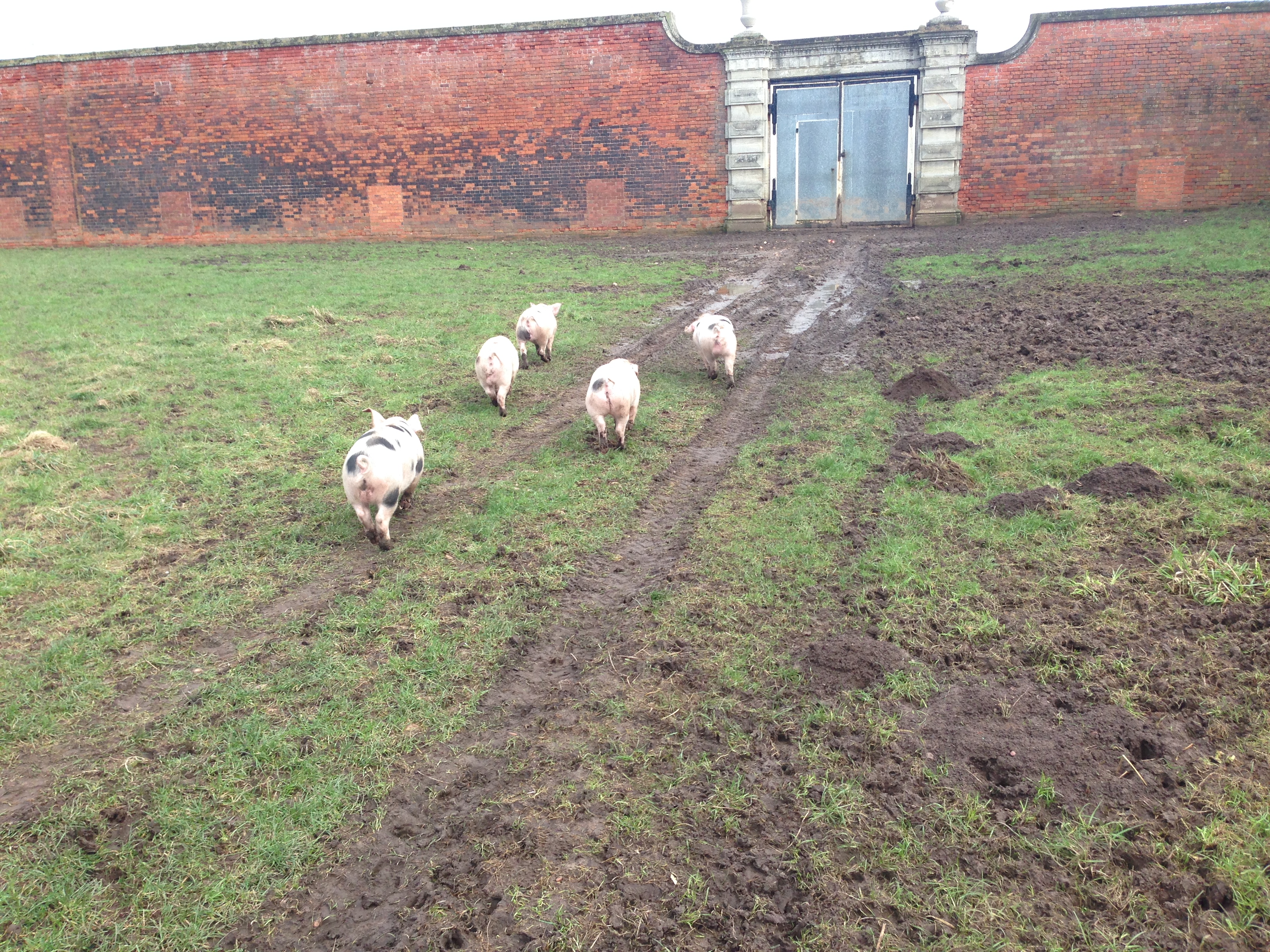
Magnificent through the estate is, that is not what drew me to the school. Rather a course that promised to educate on everything from the genetics, rearing and killing of livestock to lots of hands on butchery. It more than lived up to my expectations. We were taught by Andrew Sharp – farmersharp.co.uk – a quality meat obsessive with a huge depth of experience, passion and knowledge married with superb technical skill and no end of entertaining stories about everyone from Prince Charles to Jamie Oliver.
We looked at the theory surrounding animal genetics, looking at the difference between rare breed livestock and more modern, commercial animals. We also discussed rearing systems – grass fed versus grain fed and indoor and outdoor methods. Andrew had a really nice attitude – none of the British systems were inherently bad, with Britain having some of the highest welfare standards in the world, along with the cleanest and most humane slaughtering systems, so all British produced meat is wholesome, food safe and has acceptable minimum standards of animal welfare. What Andrew constantly wanted to educate us about was the ‘gold standard’ – how to source, age and prepare meat so that it was the best it could be. Once we had chosen the breed of animal to buy or rear, and the rearing method we considered gender – girl power definitely rules, with ladies being the tastiest, castrated males next best and entire males a distant third with rather tough meat, tasting of urea! We looked at wet aging and dry hanging, and how to choose what was appropriate for what animal, and even which parts of the carcass should be aged. A nice traditionally reared beast with a reasonable fat cover might have some of the cuts aged for around 5 weeks, but hanging the whole carcass for this long results in an extremely mouldy side of beef with a huge amount of meat lost to trimming this away, and some of the thinner outer muscles entirely spoilt. So the offal might be at its best in the first three days after slaughter, with the skirt and flank meat used in the first week and the forequarter hung for two to three weeks. The ‘pistola’ (containing the hind leg, sirloin and fillet) would then age for 4-5 weeks post slaughter for the deepest flavour and best muscle structure.
Finally we have the animal on the block, where again bad management can ruin fabulous meat. Food hygiene and an understanding of how bacteria multiply and spread was rightly emphasised over and over again. We butchered everything from rabbits to a side of beef. We spent most of the first week on pigs and sheep, with sufficient carcasses to cut a side of pork and a side of lamb each. We did the basic break up into primals – the forequarter, loin and hindquarter, and then broke up into the cuts. Most joints were boned and rolled. Our successes went to the school kitchen for lunch, and our failures were cubed or made into sausages! We made our own artisan sausages and burgers, cured bacon and made haggis and faggots from offal. We also had a pig head each, from which we removed the cheeks and other meat, to make pig cheek bacon (guanciale) and sausages. The second week we covered beef and game (venison, duck, pheasant and rabbit) and rare breed chicken. We also made a couple of visits. On the estate we visited the farm shop and butchery and the saw the Mangalitzer (hairy Hungarian) pigs. We also visited Elliot’s abattoir on the outskirts of Chesterfield, where we saw cattle being killed and looked around their fridges, gaining a better understanding of the difference of carcass types available. The abattoir was very impressive, with an incredibly efficient system and a highly professional atmosphere. It took around 10 minutes for a beast to go from live to two sides of beef. The maximum time form stunning to being bled out was one minute. The skill with which these guys used their knives, and how sharp they were certainly put our burgeoning knife sharpening and handling skills to shame!
Whilst the visit to the abattoir, skinning rabbits and mincing offal definitely stretched my ‘comfort’ zone the course has been unbelievably constructive in terms of building both my theoretical understanding and my practical butchery skills hugely. Of course you cannot learn a trade in two weeks, but I feel equipped with the tools to make the next steps in my learning journey. I also met some lovely, lovely people and hope we can keep our resolution to keep in touch!
You must be logged in to post a comment.